> For the complete documentation index, see [llms.txt](https://help.highlight.net/llms.txt). Markdown versions of documentation pages are available by appending `.md` to page URLs; this page is available as [Markdown](https://help.highlight.net/getting-started/release-notes/25.11-november-2025.md).
# 25.11 - November 2025
Release Notes 25.11 for November 2025
### Summary
In **25.11** we add the ability to alert when a controller is down.
### Alert when controller down
Be notified if your controller API integration fails.
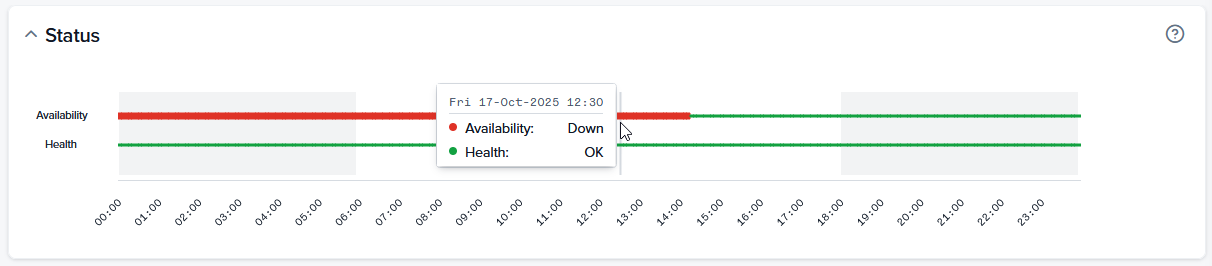
Details page chart for Controller Status watch
A parent controller may have hundreds of associated subwatches in the form of uplinks, tunnels, performance tests, etc. To limit alert spam, Highlight offers the option to suppress alerts on subwatches if the parent controller is uncontactable. Previously, this meant no alerts were sent if the controller was down. The controller status watch is designed to resolve this issue.
From 25.11, all new and existing controllers will have a controller status watch created automatically. Existing alerts configured as 'all watch types' will send stability alerts if the controller is down. Alternatively, a specific alert for controllers only can be created - see image below.
Type specific stability alert on Controllers
Find out more about [suppressing alerts when controller uncontactable.](https://help.highlight.net/getting-started/release-notes/pages/NQOZelhrfQR8Xs1Iwpda#id-10.-suppressing-alerts-when-controller-uncontactable)
### Service description
The [Highlight Service Description document](/getting-started/new-user/service-description.md) concisely describes how Highlight works and its key features. It has been updated for 25.10 and is available on the Help & Support Centre.
### Browser compatibility
All Highlight releases are tested on the current version of:
* 
#### Chrome
* 
#### Edge
* 
#### Firefox
Find out more about [Highlight supported browsers](/getting-started/useful-information/browsers-supported.md).
### Get in touch
More details on all of Highlight’s features are available on the Help & Support Centre or [contact us](/getting-started/contact-us.md) for assistance.
---
# Agent Instructions
This documentation is published with GitBook. GitBook is the documentation platform designed so that both humans and AI agents can read, navigate, and reason over technical content effectively. Learn more at gitbook.com.
## Querying This Documentation
If you need additional information that is not directly available in this page, you can query the documentation dynamically by asking a question.
Perform an HTTP GET request on the current page URL with the `ask` query parameter, and the optional `goal` query parameter:
```
GET https://help.highlight.net/getting-started/release-notes/25.11-november-2025.md?ask=&goal=
```
`ask` is the immediate question: it should be specific, self-contained, and written in natural language.
`goal` is optional and describes the broader end goal you are ultimately trying to accomplish on behalf of the user. GitBook uses it to tailor the answer towards what is most useful for that goal.
The response will contain a direct answer to the question and relevant excerpts and sources from the documentation.
Use this mechanism when the answer is not explicitly present in the current page, you need clarification or additional context, or you want to retrieve related documentation sections.